
The signs elderly cannot live alone often appear gradually, from a missed dose to a fall that goes unreported. If you worry about a parent living by themselves, this guide shows which changes matter, how urgent each one is, and what to do next. You will also see how Texas families arrange and pay for care at home, so your parents can stay safe and independent for longer.
What are the signs elderly cannot live alone?
The main signs an elderly person cannot live alone are repeated falls, medication mistakes, weight loss, poor hygiene, getting lost, unpaid bills, an unsafe home, and isolation. One sign rarely settles it. A pattern, or any immediate danger, calls for action.
We group the 12 warning signs into 4 areas, so families can compare what they see during a visit. The table shows each area at a glance.
| Area | What you may notice | Why it matters |
| Physical safety and self-care | Bruises, body odor, and a bare fridge | Injury and malnutrition can progress unseen |
| Health management | Full pill boxes, missed visits, and a recent hospital stay | Conditions can worsen between appointments |
| Memory and judgment | Scorched pots, wrong turns, and overdue bills | Emergencies demand quick decisions |
| Home and connection | Clutter, unanswered calls, and tired relatives | Nobody may notice a decline in time |
Physical safety and self-care
Physical changes often appear first, because a short visit can expose them. Watch for these 3 signs of decline in basic care:
- Repeated falls or unsteady walking: Over 14 million adults age 65 and older, or 1 in 4, report falling every year, according to the CDC. Unexplained bruises and furniture-gripping can point to falls your parents never mentioned.
- Declining hygiene: Unwashed hair, stale clothes, and skipped showers can signal that bathing or dressing has become hard. Your parents may also feel afraid of slipping in the tub.
- Weight loss and an empty fridge: Physicians generally define unintentional weight loss in adults over 65 as losing 5% of body weight within 6 to 12 months. For a 150-pound (68 kg) adult, that equals 7.5 pounds (3.4 kg), and it should prompt a medical evaluation.
Health management
Chronic conditions need steady attention, and living alone removes a daily observer. The MSD Manual notes that new symptoms can go unrecognized and that many older adults alone struggle to follow treatment plans.
- Medication mistakes: Full pill bottles, doubled doses, and expired prescriptions suggest that the routine has broken down. Ask to see the pharmacy refill dates.
- Missed appointments: Forgotten checkups, unfilled referrals, and unopened clinic letters can leave blood pressure, diabetes, and heart conditions unmonitored.
- A recent hospital stay or new diagnosis: A hip fracture, stroke, or dementia diagnosis can change what your parents can do alone. Ask the discharge planner what support the first weeks at home require.

Memory and judgment
Cognitive changes carry a distinct risk, because a person who lives alone relies on personal judgment. The Alzheimer’s Association notes that dementia can eventually limit insight into what someone can safely do.
- Getting lost or driving unsafely: New dents, wrong turns on familiar roads, and missed exits deserve attention. Ride along on a short trip of 5 miles (8 km) and observe.
- Kitchen accidents and confusion: Scorched pans, a stove left on, and spoiled food suggest slipping attention. Repeated questions and confusion about the date add to the concern.
- Unpaid bills and scams: Late notices, duplicate payments, and new “friends” on the phone can point to trouble with money. Money trouble can also expose your parents to exploitation.
Home and connection
The house and the calendar tell their own story. A home that once looked orderly can show decline months before a crisis.
- A declining home: Piled mail, broken fixtures, and an overgrown yard suggest that upkeep has outpaced your parent’s strength.
- Isolation and mood changes: Dropped hobbies, unanswered calls, and new irritability can signal depression or loneliness. About 25% of adults age 65 and older count as socially isolated, according to the MSD Manual.
- Family strain: Daily check-in calls, weekend repairs, and constant worry show that relatives already fill a care gap. That gap often grows faster than families expect.

How to determine if an elderly person can live alone
To determine if an elderly person can live alone, compare daily ability with daily demands. Clinicians use 2 groups of tasks: activities of daily living (ADLs) and instrumental activities of daily living (IADLs).
ADLs cover basic self-care, such as bathing, dressing, toileting, eating, walking, and transferring from bed to chair. IADLs cover complex tasks, such as managing money, medications, transportation, shopping, meals, housework, and phone calls.
Trouble with IADLs often appears first in people with dementia, according to geriatrician Leslie Kernisan, MD. Trouble with ADLs usually means your parents need hands-on care. Use these 5 questions, adapted from a UT Southwestern geriatric psychiatrist’s framework:
- Personal care: Can your parents bathe, dress, use the toilet, and move safely?
- Home: Do the utilities, stairs, locks, and smoke alarms work and stay safe?
- Independent living: Can your parents shop, cook, clean, and arrange rides?
- Medical self-care: Can your parents take medications correctly and report new symptoms?
- Finances: Can your parents pay bills and spot a scam?

Ask your parents to show each task, because describing it proves less. Michigan Medicine advises this for fire safety in dementia care: a person should demonstrate calling 911 or leaving the house. Take your notes to the primary care doctor or a geriatrician.
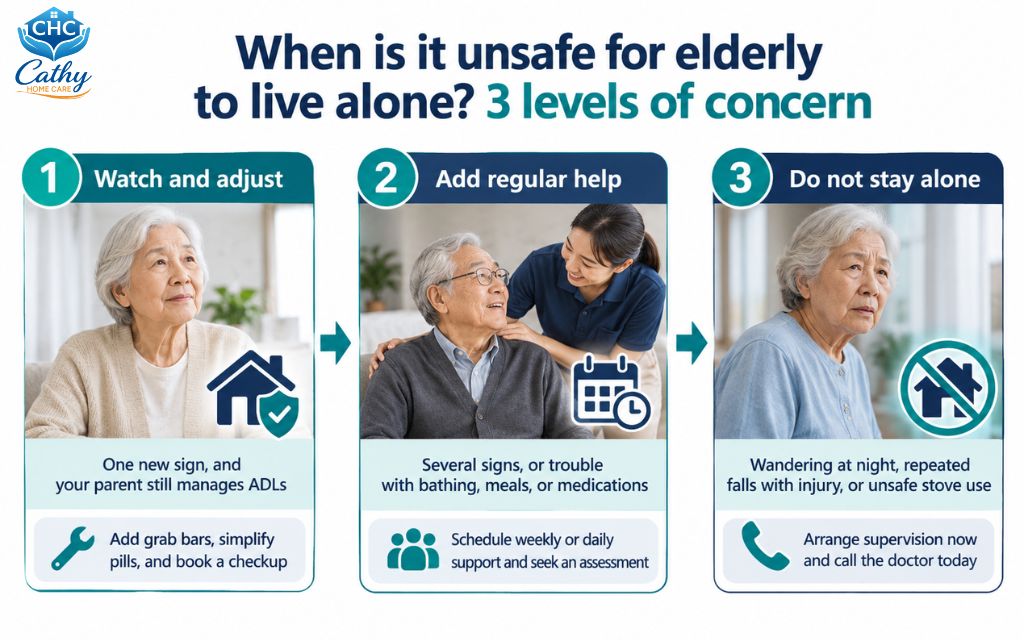
When is it unsafe for elderly to live alone? 3 levels of concern
It is unsafe for an elderly person to live alone when a known risk could cause serious harm before anyone notices. Most lists treat every sign the same. We sort them into 3 levels, so your family can match the response to the risk.
| Level | What it looks like | Family response |
| 1. Watch and adjust | One new sign, and your parent still manages ADLs | Add grab bars, simplify pills, and book a checkup |
| 2. Add regular help | Several signs, or trouble with bathing, meals, or medications | Schedule weekly or daily support and seek an assessment |
| 3. Do not stay alone | Wandering at night, repeated falls with injury, or unsafe stove use | Arrange supervision now and call the doctor today |
Treat these levels as a planning guide, because a clinician must judge each person. Call 911 for any emergency, such as a serious fall, sudden confusion, or a threat to life.
How old is too old to live alone?
No age makes someone too old to live alone, because safety depends on function. A 90-year-old with steady balance and sharp judgment may manage well, while a 72-year-old after a stroke may need daily care.
In Pew Research Center’s analysis of census data, we see that 26% of U.S. adults age 65 and older lived alone in 2023. Among adults 85 and older, the figure reached 38%. Solo living at an advanced age remains common, so age alone proves little.
Age still raises the stakes, because reserves shrink and recovery slows. For a parent in their 90s, set a backup plan even when daily life looks stable.
When should a person with dementia stop living alone?
A person with dementia should stop living alone when risks such as wandering, unsafe stove use, or night-time exits appear and supports no longer control them. Many people with early-stage Alzheimer’s live alone with help, according to the Alzheimer’s Association.
The window can close without warning, because the disease reduces self-awareness. In a 2020 study of adults 55 and older living alone with cognitive impairment, about 46% reported difficulty with daily tasks. Roughly 7 in 10 of them received no help.
Michigan Medicine’s dementia safety guide includes these 5 warning signs to review with the care team:
- Leaving cigarettes burning or pots on the stove.
- Leaving home alone or at night.
- Opening the door to strangers or giving away money.
- Falling often, or losing the ability to use a phone or alert button.
- Calling family repeatedly out of anxiety.

How long can you leave an elderly person alone?
No fixed number of hours applies, because the safe time alone depends on the person’s specific risks. For people with dementia, Michigan Medicine says short periods alone may work while round-the-clock solitude likely does not.
Test these 3 abilities to estimate a safe window: reaching help, leaving the home in a fire, and getting to the toilet safely. Then watch the night hours closely. If your parents have ever left the house at night, Michigan Medicine says they are probably unsafe alone at night.
Safety depends on what your parents can do when something goes wrong, so test the emergency and leave the routine for later.
What to do when elderly cannot live alone
When an elderly parent cannot live alone, start with evidence, a medical visit, and a family plan. These 6 steps keep decisions calm and shared:
- Record what you see: Note dates, falls, missed doses, and specific incidents.
- Book a medical evaluation: Ask the doctor to review vision, medications, memory, and mobility.
- Hold a family meeting: Assign rides, bills, and check-ins to named relatives.
- Fix the home: Install grab bars, night-lights, and stove shut-off devices.
- Choose a care level: Match the support to the level of concern above.
- Prepare documents: Name a health care decision-maker, as Henry Ford Health advises, through advance directives.
Compare care options
Care options differ in setting, skill level, and supervision. This table compares 5 common choices, so your family can pick the least disruptive option that keeps your parents safe.
| Option | Fits a parent who | Limits |
| Non-medical home care | Needs help with bathing, meals, or errands | Excludes clinical tasks |
| Home health care | Needs skilled nursing or therapy under a doctor’s order | Short visits, tied to a care plan |
| Adult day services | Benefits from daytime supervision and company | Covers daytime hours only |
| Assisted living | Needs daily help and on-site staff | Requires a move |
| Nursing home | Needs 24-hour nursing care | Offers the least independence |
In-home support often fits levels 1 and 2. Home care stops being enough when your parents need constant supervision that the schedule and family cannot cover. Residential care then becomes the safer path.

How Texas families can pay for care at home
Texas families usually pay for care at home through Medicaid programs, long-term care insurance, or private funds. Medicare covers less than many families assume. Each payer sets its own rules, so confirm benefits before you plan around them.
Medicare pays for part-time skilled home health care when a person is homebound and a doctor orders it. It excludes round-the-clock care and meal delivery. It also excludes personal care, such as bathing and dressing, when that is the only care needed.
Texas Medicaid offers separate paths for people who meet financial and functional rules:
- Primary Home Care (PHC): Non-skilled personal care for people with Medicaid whose long-term health problems limit self-care.
- Community Attendant Services (CAS): Non-skilled attendant care for people with functional limits whose income exceeds the PHC limit.
- STAR+PLUS Home and Community Based Services: Long-term services and supports as an alternative to nursing facility placement.
Long-term care insurance may also pay for home care, depending on the policy. Benefits often begin when a person needs help with ADLs, so your ADL notes can support a claim.

Where to get help in Houston
Harris County residents can start with the Care Connection Aging and Disability Resource Center. It connects older adults, people with disabilities, and caregivers with community programs and long-term services.
The Houston Health Department’s Harris County Area Agency on Aging helps operate this center. For dementia questions, the Alzheimer’s Association helpline answers 24/7 at 800.272.3900.
What if your elderly parent insists on living alone?
If your elderly parent insists on living alone, respect the choice, reduce the risks, and revisit the plan often. Adults with decision-making capacity can refuse help, even when the choice worries their family.
Fear of losing control often drives the refusal. On an AARP caregiving forum, one adult child described a 93-year-old father who told the family, “Just because I am 93 doesn’t mean I can’t take care of my wife.” These 4 approaches can lower the resistance:
- Start small: Book 2-hour visits, 2 or 3 times a week, for housekeeping.
- Name the goal: Present help as the way to stay home.
- Invite the doctor: Ask a trusted physician to recommend support.
- Offer choices: Let your parents pick the days, tasks, and caregiver.

Texas Adult Protective Services (APS) serves adults 65 and older, plus younger adults with qualifying disabilities. APS cannot force services on an adult who refuses them. It also cannot make an adult leave home unless an emergency threatens life or safety and the adult lacks capacity.
Neglect can be self-inflicted, according to DFPS. Report suspected abuse, neglect, or exploitation at 1-800-252-5400, and call 911 in an emergency.
Legal tools work best before a crisis. Texas lists alternatives such as power of attorney and supported decision-making, and courts must consider them before appointing a guardian. Speak with a Texas elder law attorney about your situation.
When you can no longer care for an elderly parent
You have reached your limit when caregiving harms your health, work, or safety, or when your parent’s needs exceed your skills. Lost sleep, missed shifts, and constant dread are signals, and they deserve the same attention as your parent’s symptoms.
Stepping back from hands-on tasks keeps you involved in your parent’s life. Share duties with siblings, ask the doctor for a social work referral, and add outside care. The MSD Manual also supports home services and emergency response devices for older adults alone.
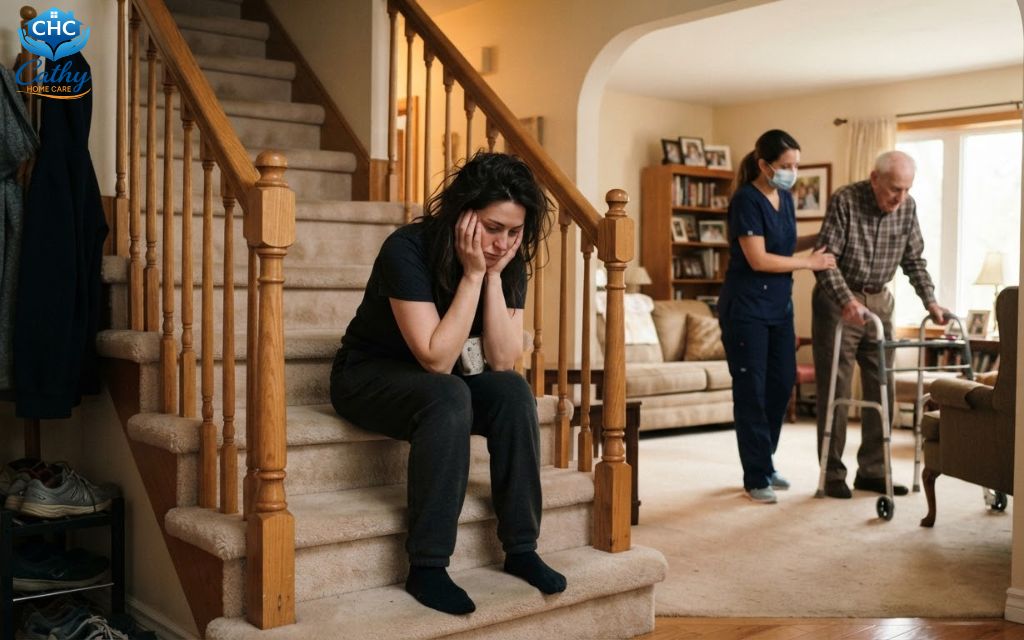
How Cathy Home Care supports Houston families
Cathy Home Care is a Houston home care agency that helps families act on the signs elderly cannot live alone. Since 2002, we have helped seniors and people with disabilities stay at home through personal assistance, home health aide support, and Primary Home Care for eligible clients.
Our caregivers assist with bathing, dressing, mobility, meals, and light housekeeping. We build each plan around your parent’s routine, values, and family needs. Our team also helps families understand Medicaid and long-term care insurance options, and approval depends on each payer.
Our team speaks English, Vietnamese, Spanish, and Chinese, so more relatives can join the conversation. Skilled nursing and therapy come through partner providers.

Living alone can stay safe longer with the right support, and early action protects that choice. Contact Cathy Home Care to talk through the signs elderly cannot live alone in your family.
FAQs about signs elderly cannot live alone
Can a 90-year-old live alone?
Yes, a 90-year-old can live alone when they manage daily tasks, medications, and emergencies safely. A backup plan and regular check-ins matter more at this age, because a small setback can change daily ability.
What is the biggest warning sign that an elderly parent needs help?
Repeated falls rank among the most serious warning signs. The CDC names falls as the leading cause of injury and injury-related death among adults 65 and older. Book a medical review after any fall.
Can someone with early dementia still live alone?
Yes, many people with early-stage Alzheimer’s live alone with support. Regular check-ins, meal help, and medication systems make this safer. Review the arrangement often, because abilities change
Does Medicare pay for someone to stay with an elderly person at home?
No, Medicare does not pay for round-the-clock care at home. It also excludes personal care when that is the only care a person needs.
Can you force a parent to move if you see signs elderly cannot live alone?
No, you generally cannot force an adult with decision-making capacity to move. In Texas, even APS cannot force services on an adult who refuses them. Guardianship requires a court process, so consult an attorney.
What is the difference between home care and home health care?
Home care provides non-medical help with daily living, while home health care provides skilled services under a doctor’s order. A parent may need one or both.